'%20stroke='url(%23pc-grad)'%20stroke-width='3'%20stroke-linejoin='round'%20stroke-linecap='round'%20fill='none'%3e%3cpath%20d='M14%2012%20H46%20a8%208%200%200%201%208%208%20v14%20a8%208%200%200%201%20-8%208%20H36%20l-8%208%20v-8%20H14%20a8%208%200%200%201%20-8%20-8%20V20%20a8%208%200%200%201%208%20-8%20z'/%3e%3cpath%20d='M18%2022%20H42'%20/%3e%3cpath%20d='M18%2028%20H38'%20/%3e%3cpath%20d='M18%2034%20H34'%20/%3e%3c/g%3e%3cg%20fill='url(%23pc-grad)'%20filter='url(%23pc-glow)'%3e%3cpath%20d='M40%2038%20l10%2010%20-3%206%20-3%20-3%20-6%203%20z'%20opacity='0.95'/%3e%3ccircle%20cx='44'%20cy='49'%20r='1.5'%20fill='%230b0b14'/%3e%3c/g%3e%3c/svg%3e)
Underwater Floating Door Scene
A surreal underwater composition of a floating person beneath a mysterious white door, illuminated by volumetric light rays in deep blue water.
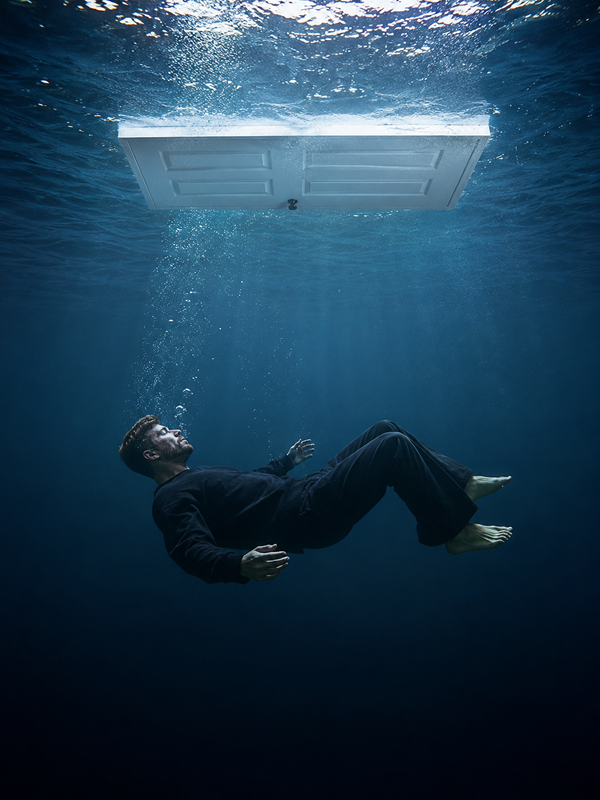
Generate a photorealistic full-body underwater photograph of a person in dark, loose clothing floating horizontally beneath the surface, their spine parallel to the frame's bottom edge, head to the left and feet to the right. The person's arms are relaxed with open palms, knees loosely bent, face tilted upward toward the surface with a gentle gaze, and fine bubbles rising diagonally from their body toward the upper portion of the frame. A whitish four-panel door floats horizontally in the upper third of the image, centered and positioned just below the rippling water surface, its bottom side visible with four legible embedded rectangles and a small dark knob near the lower middle edge, with silver foam and reflections gathered just above it. The water forms a deep gradient from cobalt blue near the surface to nearly black at the bottom, creating considerable negative space around the subject. Lighting comes only from above with soft volumetric rays and crisp highlights on the lower portion of the door, minimal backscatter, sharp detail in the bubbles and clean edges throughout. The color palette features cinematic bluish-teal tones with neutral whites. No fish, particles, text, or additional elements.
Try this prompt in
How to Use This Prompt
Underwater Floating Door Scene is a ready-to-use AI image prompt designed for creative ai art who want consistent, high-quality results without spending hours on trial and error. A surreal underwater composition of a floating person beneath a mysterious white door, illuminated by volumetric light rays in deep blue water.
Use this prompt whenever you need polished visuals for creative ai art workflows — typical moments include client work, content production, classroom prep, and rapid iteration on ideas. Copy the full prompt, paste it into your preferred AI tool, and replace any bracketed placeholders with your own specifics (topic, brand, subject, or constraints).
For best results, give the model a clear context line before pasting, keep your replacements concrete (numbers, names, examples), and regenerate 2–3 variations to pick the strongest composition. Pair it with the customization tips below to adapt it to your exact use case.
Example Output
Expect a sharp, well-composed image with clean subject framing, balanced lighting, and Underwater, Floating Door details suitable for direct use in social posts, thumbnails, or product mockups.
Prompt Details
Customization Tips
- Swap the subject for your own — replace the main noun with your product, character, or scene.
- Change the lighting (golden hour, studio softbox, neon night) to shift the mood.
- Add a specific camera or lens reference (e.g. "shot on 35mm, f/1.8") for a photo feel.
- Lock the aspect ratio to match your platform (9:16 for Reels, 16:9 for YouTube).
- Add or remove a style modifier like "cinematic", "minimalist", or "editorial".
- Specify a color palette in hex or named colors to match your brand.
- Append "no text, no watermark" to keep outputs clean.
- Use negative prompts (e.g. "no blur, no extra fingers") if your model supports them.
Frequently Asked Questions
What is the "Underwater Floating Door Scene" prompt used for?
A surreal underwater composition of a floating person beneath a mysterious white door, illuminated by volumetric light rays in deep blue water.
Which AI models work best with this prompt?
It works across all major models, but you'll get the strongest results from Midjourney v6, Flux 1.1 Pro, GPT-4o Image.
Is this prompt free to use?
Yes. Every prompt on PromptCraft is free, requires no signup, and can be copied with one click for personal or commercial projects.
Can I use the generated image commercially?
Commercial rights depend on the AI image tool you use. Most paid tiers (Midjourney, Flux Pro, GPT-4o Image) grant commercial usage — check the model's current terms.
Why is my output different from the example?
AI models are non-deterministic — the same prompt produces variations each run. Regenerate 2–3 times and pick the strongest result, or refine with a short follow-up instruction.